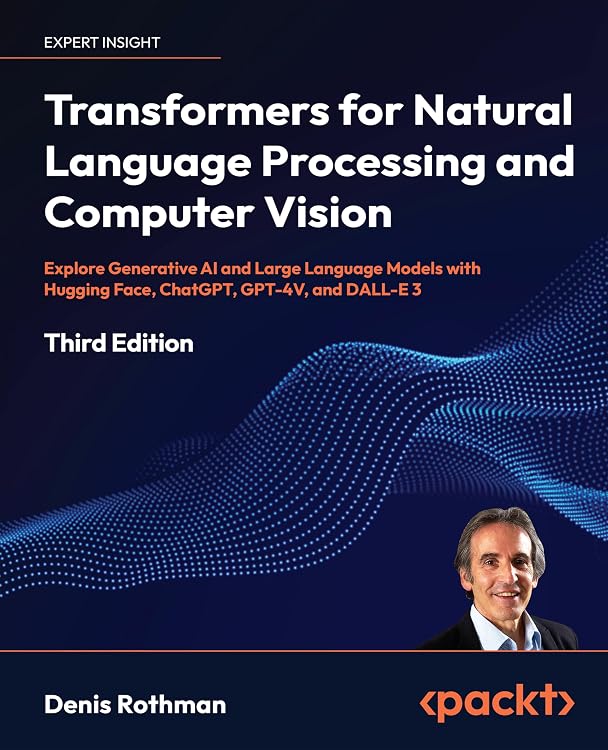
Transformers for NLP and Computer Vision, 3rd Edition
Transformers for Natural Language Processing and Computer Vision, Third Edition, is a 728-page technical guide to transformer models, LLMs, and multimodal AI. It covers model architecture, pretraining and fine-tuning, RAG, risk mitigation, and computer-vision applications, with examples involving Hugging Face, OpenAI, and Google Vertex AI.
At a glance
- Explains transformer architectures including BERT, GPT, T5, PaLM, ViT, CLIP, and DALL-E.
- Covers pretraining and fine-tuning, tokenization, and practical model-development examples.
- Includes RAG and embedding-based search for question answering and mitigating hallucinations.
- Adds computer-vision and multimodal topics, including image and video classification.
Reference price: $54.99
Price checked: Nov 14, 2026
View offerAhead of Black FridayExplore the selectionOften bought together
Pros and cons
Pros
- Combines NLP and computer-vision coverage with hands-on topics spanning training, RAG, and model interpretation.
- Includes discussion of risks such as hallucinations, memorization, and privacy alongside mitigation approaches.
- The listing says Python familiarity and basic machine-learning concepts are helpful, while also describing UI, prompt-engineering, and no-code examples.
Cons
- The breadth across NLP, LLMs, and computer vision may be less focused than a book dedicated to one of those areas.
Technical specifications
8 specifications| Edition | 3rd |
|---|---|
| Publisher | Packt Publishing |
| Publication date | February 29, 2024 |
| Language | English |
| Print length | 728 pages |
| ISBN-13 | 978-1805128724 |
| Weight listed | 2.72 pounds |
|---|---|
| Dimensions | 7.5 x 1.65 x 9.25 inches |
What to know before buying
- The listing says familiarity with Python and basic machine learning helps readers follow the use cases and code examples. It also presents some UI, prompt-engineering, and no-code examples as accessible to curious readers.
Who is it for?
A good fit for
- NLP and computer-vision engineers seeking a wide-ranging reference on transformers and generative AI.
- Data scientists, machine-learning practitioners, and software developers who want examples involving model training, RAG, and multimodal applications.
- Technical leaders comparing platforms and models, with foundational Python or machine-learning knowledge useful for the code examples.
Less suited to
- Readers seeking a narrowly focused introduction to only one model family or one AI application area.
- Readers who want a book with no code or no reliance on prior Python and machine-learning familiarity.
Customer reviews on Amazon
- 5 stars
62% 62% - 4 stars
12% 12% - 3 stars
15% 15% - 2 stars
2% 2% - 1 star
9% 9%
Customer feedback describes the book as a useful resource and appreciates explanations that break complex material into digestible sections. Reports on conciseness are mixed, so readers who prefer a compact, tightly edited treatment may find the book's broad coverage less suited to that preference. That breadth is reflected in the listed 728-page length and its coverage of NLP, LLMs, RAG, and computer vision.
Positive themes
- Customers describe the book as a useful resource and praise explanations that make complex topics digestible.
- Comprehensiveness is a reported positive aspect.
Mixed feedback
- Feedback on conciseness is mixed, with some readers finding complex material easy to grasp while others feel it could be more concise.
Frequently asked questions
What subjects does this book cover?
It covers transformer architectures, LLM pretraining and fine-tuning, RAG, risk mitigation, and vision and multimodal applications.
Does it include practical examples?
The listing describes hands-on work with model training, embedding-based search, RAG, image and video classification, and tools for visualizing model activity.
What background is useful?
The listing says Python and basic machine-learning knowledge help with its use cases and code examples. It also describes some interface, prompt-engineering, and no-code material.
Which edition is this?
The listing identifies it as the third edition, published February 29, 2024.
Alternative options
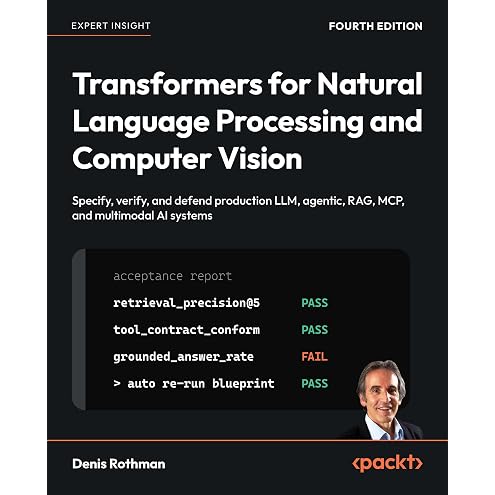
Transformers for Natural Language Processing and Computer Vision: Specify, verify, and defend production LLM, agentic, RAG, MCP, and multimodal AI systems
$52.24
Build a Reasoning Model (From Scratch)
$47.99
Transformers: The Definitive Guide: Applications Beyond NLP
$57.19
Deep Learning: Foundations and Concepts
$51.48
The Lean AI Handbook: Building, Deploying, and Scaling AI for Business Value
$43.38
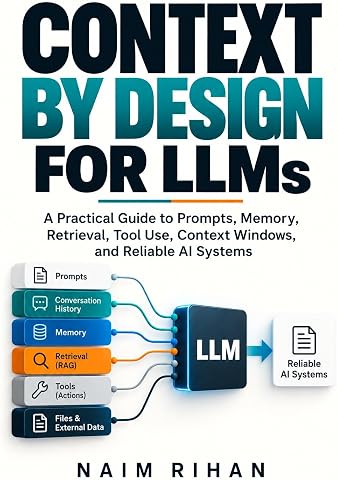
Context by Design for LLMs: A Practical Guide to Prompts, Memory, Retrieval, Tool Use, Context Windows, and Reliable AI Systems
$4.99
Generative AI Foundations: Build, Fine-Tune, and Deploy Generative Models for Text, Images, and Multimodal Applications
$19.99
AI Evals in Practice: Testing, reliability, and quality for LLM systems in production
$34.99
The Practical Network Engineer's Guide: Master routing, network diagnostics, and troubleshooting
$39.99
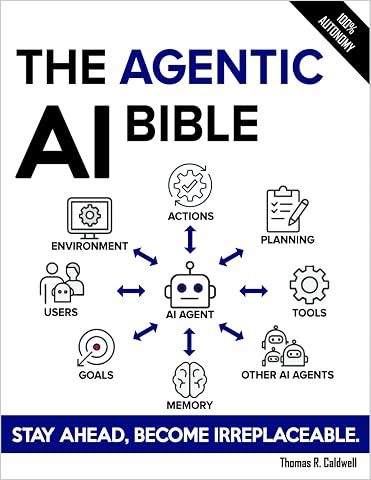
The Agentic AI Bible: The Complete and Up-to-Date Guide to Design, Develop, and Scale Goal-Driven, LLM-Powered Agents that Think, Execute and Evolve
$24.95
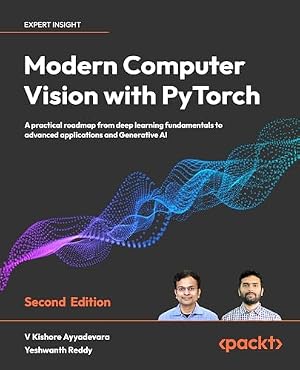
Modern Computer Vision with PyTorch: A practical roadmap from deep learning fundamentals to advanced applications and Generative AI
$48.79
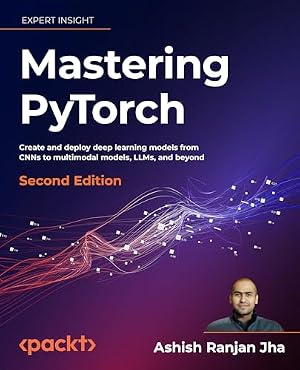
Mastering PyTorch: Create and deploy deep learning models from CNNs to multimodal models, LLMs, and beyond
$34.58